Somewhere between the positive test and the first ultrasound, almost every expecting parent runs the same mental slideshow. Your nose or theirs. Whose eyes. Whether that dimple carries over.
It is one of the most-searched questions on the internet, and it has an unsatisfying honest answer: nobody knows, and no tool can tell you. Not an app, not a calculator, not an AI model, not a doctor.
That is a strange thing to open with on a site that runs a baby generator. The alternative is worse. There is a whole category of sites promising "99% accurate" predictions of a child who does not exist yet, and every one of those numbers is invented. We would rather explain what the technology genuinely does, so the thing you get out of it lands the way it should — as something fun and slightly uncanny, not as a forecast.
The short answer
Your baby will look like some combination of you and your partner, in proportions nobody can calculate in advance, plus a set of features that appear in neither of you and trace back to grandparents or further.
That last part is the piece people underestimate. Children routinely arrive with hair or a jawline that skipped two generations. This is ordinary, not unusual.
So when a tool shows you a face, it is not reading the future. It is doing something much simpler, and worth understanding properly.
What an AI baby generator is actually doing
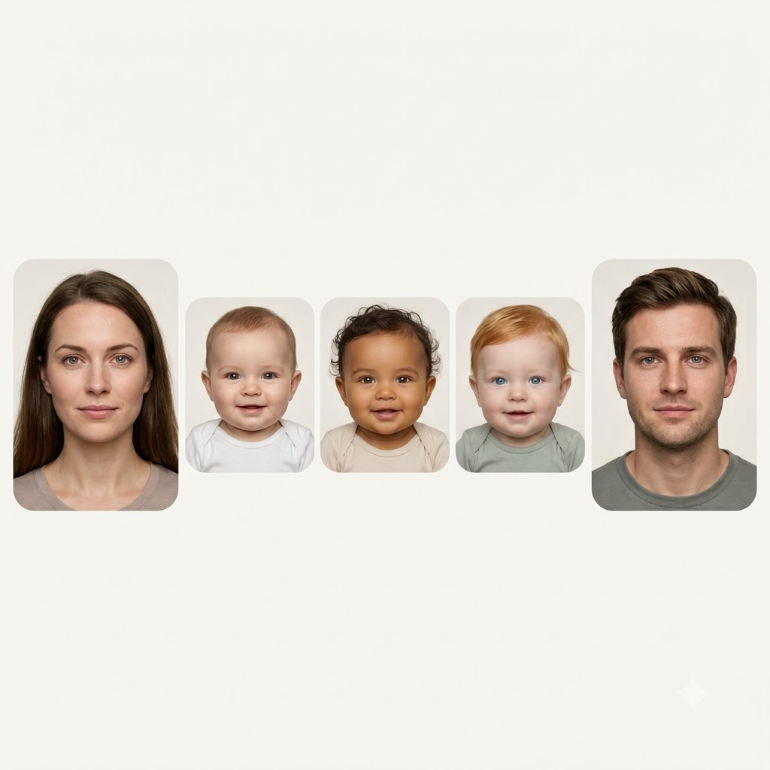
It takes two photographs and produces a new face that shares visual characteristics with both.
That is the whole operation. Read it twice, because the marketing language around this category works hard to obscure it: the tool is working from your photos, not from your biology. It has no access to your DNA. It has never seen your family. It does not know your grandmother had red hair.
What it has is one facial image of each of you, and a model trained to produce plausible faces carrying features from both inputs. Ours generates across five life stages — baby, kid, teenager, adult, elderly — with each stage generated separately rather than aged forward from a single image.
The distinction that matters
Two different things get sold as the same product.
Prediction would mean taking genetic information and calculating probable outcomes. That requires a lab, and even then it produces probabilities for a handful of traits, not a portrait.
Blending means taking two images and generating a face that visually shares features with both. That is what this is. That is what every tool in this category is, whatever its landing page says.
We say this on the product pages too and we will keep saying it: this is an entertainment tool that blends facial features. It is not a genetic prediction, it is not a medical service, and no result it produces should be read as information about a real or future child.
What actually shapes a child's face
If the tools can't tell you, what can? Only broad principles — and this is where a lot of content in this space quietly oversteps into territory it has no business in.
Most visible traits involve many genes at once. The Punnett squares from school biology, where one dominant and one recessive gene neatly settle an outcome, describe a small number of traits. Eye color, hair color, height, and facial structure each involve multiple genes interacting.
Eye color is the instructive example, because it is the one nearly everyone was taught incorrectly. Two genes sitting close together on chromosome 15, OCA2 and HERC2, do most of the work, with smaller contributions from several others, producing a continuum of colors rather than a set of boxes. Researchers once modeled it as a single gene with brown dominant over blue; that model turned out to be too simple, which is why blue-eyed parents can — uncommonly — have a brown-eyed child. MedlinePlus Genetics, from the U.S. National Library of Medicine, lays this out clearly.
This is why simple calculators mislead. A two-parent eye color calculator can describe what is more likely across a large population. It cannot tell you about your child, because your child is one outcome, not an average.
Newborn appearance is not final appearance. Many babies are born with little pigment in the iris, which is why so many pairs of eyes look blue at birth. Pigment accumulates over the following months, and for most children the color has settled after the first year — though for some it keeps shifting for several more. (Sources: American Academy of Ophthalmology, "Your Blue Eyes Aren't Really Blue"; American Academy of Pediatrics, HealthyChildren.org.)
Features skip generations. Traits from grandparents and great-grandparents can surface in a child even when neither parent shows them.
That last point is the honest limit on any photo-based tool. Working from two adult faces, a model has no way to know what is carried but not visible.
A note on scope. This section stays deliberately general. Questions about inherited conditions, pregnancy, or anything with a health dimension belong with a doctor or a genetic counselor, not with a blog post and certainly not with an image generator.
So why do people use these tools?
Given all of the above, the reasonable question is why anyone bothers.
Because the appeal was never accuracy. Couples send the results to each other at work. Expecting parents put them in announcements. People nowhere near having children run their photos through out of pure curiosity. It sits closer to a photo booth than to a diagnostic.
The results are most interesting when you stop asking "is this right?" and start asking "what did it pick up?" Sometimes a generated face lands on a specific feature — the set of the eyes, the shape of a chin — in a way that is genuinely startling. Not because it predicted anything, but because it found something the two source faces have in common that you had never consciously noticed.
That is a real thing image models are good at. It just isn't prophecy.
Getting a result worth looking at
Output quality is mostly determined by input quality, and the gap between a good source photo and a bad one is much wider than most people expect. The reason is simple: a face is distinctive because of small structural details, and a photo that obscures those details leaves less specific structure to work from. The output then drifts toward an average, and averages look generic because that is exactly what they are.
What helps:
- Front-facing, both eyes visible
- Even, diffuse lighting — window light beats overhead light, which beats flash
- Neutral or lightly smiling expression
- The face occupying a decent share of the frame
- Sunglasses off, hair off the face, hat off
What hurts:
- Group shots cropped down to one face
- Heavy filters or beauty smoothing, which strip the exact detail the model needs
- Strong side lighting that erases half the face
- Extreme angles, laughing, mid-motion
- Low resolution or heavy compression
The single most useful change available to most people is lighting. Face a window in daylight instead of standing under a ceiling light, and you will fix more bad results than every other item on this list combined.
There is a full walkthrough in our guide to making an AI baby step by step.
One more thing worth knowing: models in this category sample rather than compute. They produce one plausible face from a space of plausible faces, which is why results in this category vary rather than settling on a single fixed answer. A tool that returned an identical face every time would be making a much stronger claim than any of them can support.
Your photos
Uploading pictures of your face to a website is not a trivial act, and anyone who tells you it is has an interest in you not thinking about it.
Two questions are worth answering for any tool in this category, ours included: whether uploaded photos are stored after processing and for how long, and whether the images leave the company you handed them to.
Our own answers, since it would be poor form to set a test we don't sit: uploaded photos are deleted 24 hours after they arrive, on a schedule rather than on request. Generation runs through a third-party image model, so a photo does leave our servers to be processed. There is a support address on the privacy policy, along with the rest of the detail.
And one that applies to every tool including ours: you need the other person's permission. Uploading a photo of your partner, your ex, or a stranger without their agreement is not a gray area, and "it was just for fun" is not a defense anywhere it matters.
Where to go from here
This guide covers the general question. Three companion pieces go deeper:
- What Will Our Baby Look Like? A Guide for Couples — for two people doing this together, including the conversation about photos that usually comes first.
- What Will My Kids Look Like? — the plural version: siblings, why they differ, and why the result changes between runs.
- What Will My Child Look Like? — looking past infancy at older life stages, and why they get vaguer.
If you want to try it, the AI baby generator takes two photos and works from there. Every plan is a single payment with no subscription — a deliberate choice, given how much of this category runs on recurring billing that people struggle to cancel.
Common questions
Can any tool actually predict what my baby will look like? No. Tools quoting accuracy percentages are inventing them. What these tools do is blend two faces into a plausible third.
Why do I get different results from different tools? Different models trained on different data make different choices. None of them is closer to the truth, because there is no truth to be closer to yet.
Does it work with only one parent's photo? No — two photos, one of each parent. The whole operation is a blend of two faces, so a single photo leaves nothing to blend with.
Will the result look like my actual baby? Possibly, in parts, by coincidence. Read it as an image, not a preview.
Is it free? It isn't. Every plan here is a single payment, with no subscription and nothing to cancel afterwards; what each pack includes is on the pricing page. Most apps in this category work the other way round — free to download, then a weekly subscription at the moment the result appears. We went through that pattern here.
Can I upload a photo of a child? No. Only photos of adults who have agreed to it.
The bottom line
The question in the title has a real answer, and it isn't a picture. Your two faces define a range of plausible outcomes. A child arrives somewhere inside that range, and which point they land on is settled by a process no photograph records.
What a generator gives you is one plausible sample from that range, rendered well enough to be delightful. That is worth an evening. It is not worth building an expectation on.
Drafted with AI assistance and reviewed, fact-checked and edited by a human before publication. Every claim about how our product behaves was checked against the product; every claim about heredity is either cited above or was removed. No statistic in this article was generated by an AI.