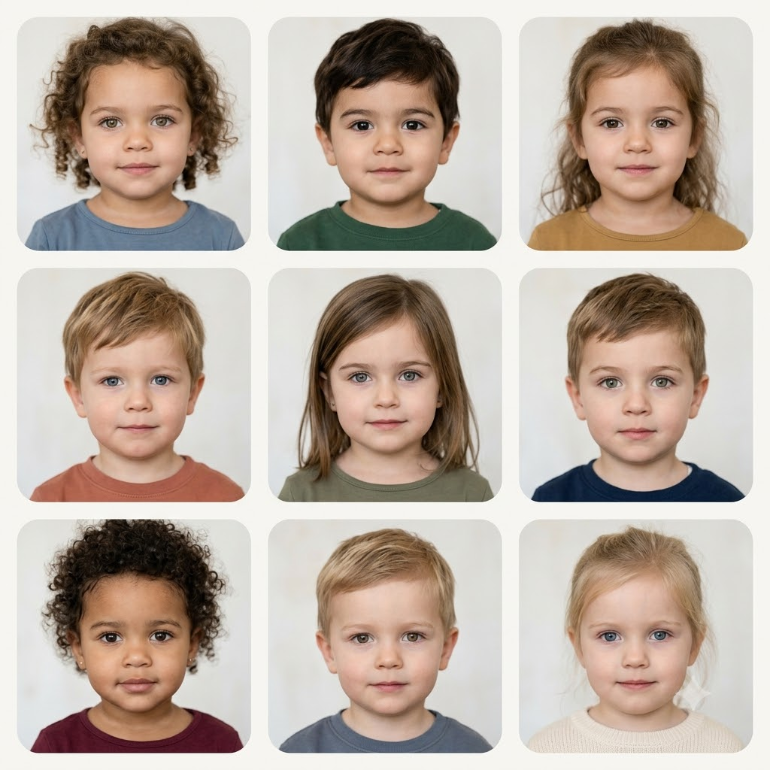
If you are asking about kids rather than a baby, you are usually asking a second question underneath the first: why do siblings from the same two parents sometimes look like strangers to each other?
That has a real answer. It also explains something people find confusing about AI baby generators — why the result changes every time you press the button.
Why siblings look different
Each parent passes on half of their DNA, but not the same half each time.
When egg and sperm cells form, chromosomes are shuffled and recombined. Every child receives a different draw from the same deck. Full siblings share roughly half their DNA on average — and "on average" is doing an enormous amount of work in that sentence. Two siblings can share noticeably more than half, or noticeably less.
Then add two things people routinely forget.
Recessive variants surface unpredictably. A feature neither parent visibly has can appear in one child and not another. Eye colour is the clearest illustration: it was taught for decades as one gene with brown dominant over blue, and that model turned out to be too simple. Two genes on chromosome 15, OCA2 and HERC2, do most of the work, with smaller contributions from several others — which is why the outcome is a continuum rather than a set of boxes, and why blue-eyed parents can uncommonly have a brown-eyed child. MedlinePlus Genetics, from the U.S. National Library of Medicine, sets this out properly.
Grandparents are in the mix. A child can look strikingly like a grandparent, showing features neither parent visibly carries. That resemblance was always available in the deck; it simply was not dealt to the parents.
This is a general explanation of inheritance, not medical advice, and our tool is not a genetic test. For questions about inherited conditions, speak to a doctor or a genetic counsellor.
Why the AI gives you a different child each time
Here is the part that connects.
An image model does not compute one correct answer and return it. It samples — it produces one plausible face from a space of plausible faces, and a different run lands somewhere else in that space. Press the button five times and you get five children.
People read this as a fault. It is closer to the opposite. A tool that returned the identical face every time would be making a much stronger claim than it can support, because it would be implying there is one answer. There is not one answer. There is a range, and each run shows you a point in it.
The analogy to real siblings is loose but useful. The spread across repeated runs is a property of how the model samples, not a measurement of genetic variance — those are different mechanisms that happen to rhyme. But the shape of the lesson holds: your future children are also several draws from a range defined by the two of you, and the range is wider than a single picture suggests.
Which means one image is the worst way to use this
If you run it once and treat that face as "our child", you have thrown away the informative part of the output.
Run it a few times and look for what persists. A nose shape that turns up across most of your results is telling you something about how the blend reads your two faces. A nose shape that turns up once is telling you about that one sample. The stable core across runs is where the parental resemblance actually lives — the variation around it is the model showing you its own uncertainty, which is more honest than most tools in this category manage.
Two practical notes:
- Keep the input photos identical between runs. Change the photo and you are testing photo quality, not variation. Which of the two you are testing matters — the step-by-step guide covers the photo side separately.
- Check what your plan covers before you plan a big comparison. Ours is a one-time payment for four portraits, so decide in advance whether you want four runs at one stage or one run across several stages.
What this tool cannot do
Being direct, because the limits matter more than the feature list.
It cannot tell you how similar your future children will be to each other. The variation between runs is a property of the model, not a forecast about your family.
It cannot show you a child and their sibling. Two runs give you two independent samples, not a modelled sibling pair. There is no relationship between them beyond the shared inputs.
It cannot account for recessive variants or grandparents. It sees two photographs. Everything not visible in those photographs is invisible to it.
It cannot say anything about twins, birth order, or a real pregnancy.
If you want the full picture on what these tools can and cannot show, that is in what will my baby look like.
A note on what the spread is good for
There is a version of this that is genuinely worth doing with someone, and it is not "which one is our child".
Generate several. Put them side by side. Notice that you can pick out the family resemblance across all of them even though no two are the same face — that is the interesting result, and it is the same reason you can recognise siblings you have never met as siblings. A range with a recognisable centre is exactly what two faces produce, in silicon and otherwise.
Frequently asked questions
Why does the result change each time I run it? The model samples from a range of plausible faces rather than computing one fixed answer. Running it several times shows you the range, which is more informative than any single result in it.
Can it show me what my two kids would look like together? No. Two runs give you two independent samples, not a modelled sibling pair.
How different can real siblings actually be? Very. Full siblings share about half their DNA on average, but the specific half differs every time, and recessive variants plus grandparent resemblance widen the range further.
So is the AI wrong, or are the different results all valid? Neither framing quite fits. None of them is a prediction of a real child, so none can be right or wrong in that sense. Each is a plausible blend of the two faces you gave it.
Does it use a photo of a child we already have? No. It works from the two parent photos only.
Is it free? No. It is $1, once, for four portraits, with nothing to cancel afterwards. Most apps in the category are free to download and charge at the result instead — the pattern is worth knowing.
The bottom line
Siblings differ because inheritance is a draw, not an average. A generator gives you a different face each run for an unrelated technical reason that happens to teach the same lesson.
Both point the same direction: there is no single face waiting at the end of this question. There is a range, your children will land somewhere in it, and the honest thing a tool can show you is the shape of the range rather than a confident guess at the answer.
This article was drafted with AI assistance and reviewed, fact-checked and edited by a human before publication.