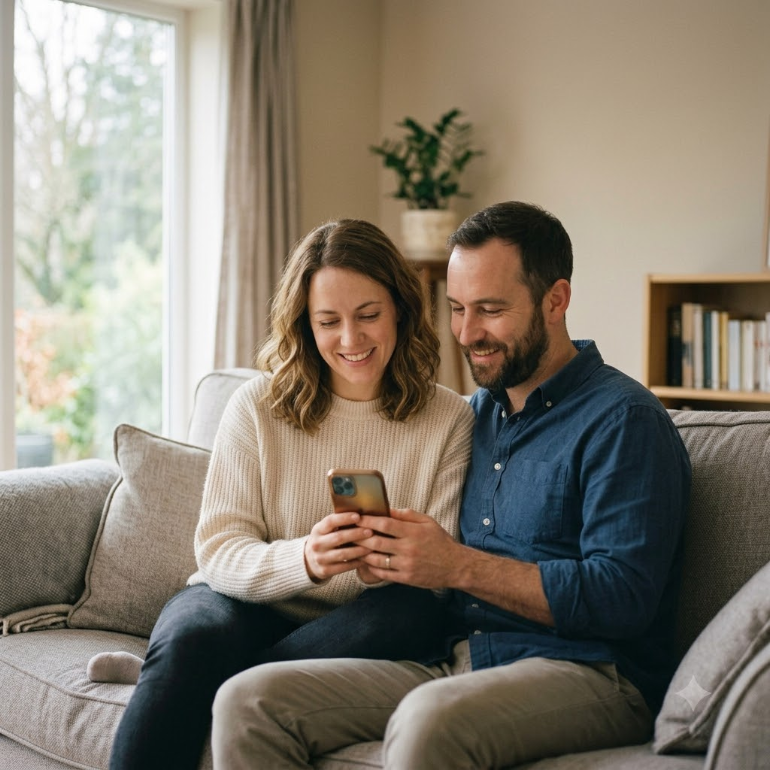
Doing this as a couple is a different thing from doing it alone. You need two people to agree on it, two usable photos, and — more often than anyone admits — one conversation about where those photos are going.
That conversation is what this guide is mostly about, because it is the part that actually stops people, and because "just convince them" is a bad answer.
If what you want is the accuracy question, that is over here. If you want the mechanics of getting a good result, the step-by-step guide covers photos in detail.
When your partner doesn't want to share a photo
Start here, because it is the most common sticking point and the one handled worst everywhere else.
A face photo is biometric data. Being cautious about where it goes is a reasonable position held by reasonable people — not an obstacle to be worked around. If your partner hesitates, the useful move is to answer the specifics rather than to push.
There are three questions worth having answers to, for any tool you are considering:
- What happens to the photo, and for how long is it kept?
- Who processes it, and does it leave the company you gave it to?
- Is there a real person you can contact about deleting it?
Our own answers, since it would be poor form to set a test we do not sit: uploaded photos are deleted 24 hours after they arrive, on a schedule rather than on request. Generation runs through a third-party image model, so a photo does leave our servers to be processed. There is a support address on the privacy policy, along with the rest of the detail.
If your partner reads that and still says no, that is the end of it. Uploading someone's face without their agreement is not a grey area, and depending on where you live it may not be legal. "It was just for fun" is not a defence anywhere it matters.
This applies with more force, not less, to a partner you are no longer with.
The two photos, briefly
The full version of this is in the step-by-step guide. The short version, for a couple standing in a kitchen deciding whether to bother:
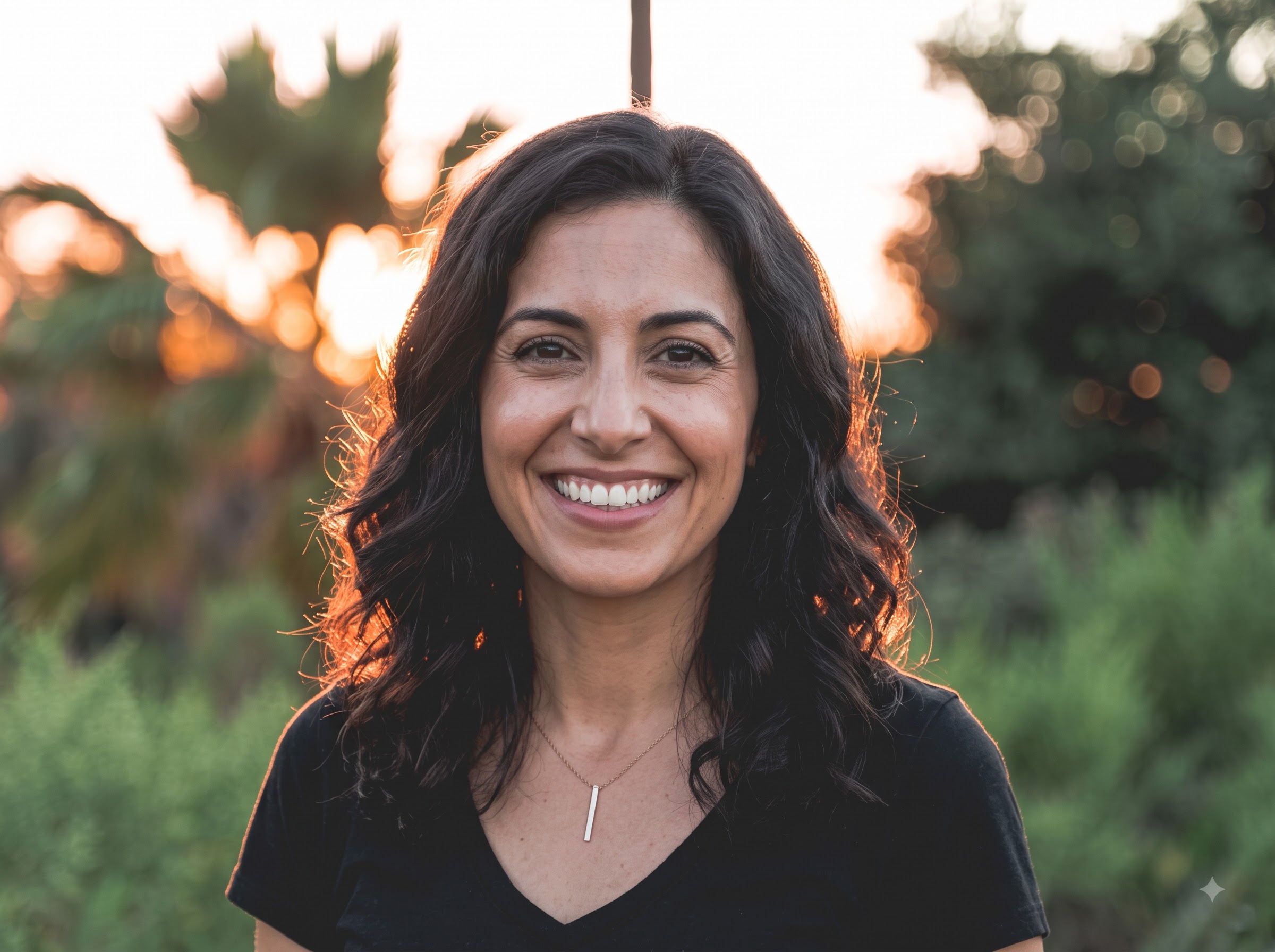
Take two new photos rather than hunting through the camera roll. Face a window, camera at eye level, neutral or a soft closed-mouth smile, nothing across the face. Thirty seconds each, and it will beat anything you find in your photos from last summer.
The one thing worth adding for couples specifically: take both photos in the same place, in the same light. Two faces recorded under matching conditions blend more cleanly than one shot in a bright kitchen and one in a dim bar. It is the single easiest improvement available to you and almost nobody does it.
What to do with a result you disagree about
A few patterns are common enough to be worth naming.
One of you thinks it looks like nobody. Usually the photos. Occasionally the age setting — a generated twelve-year-old is a much vaguer object than a generated newborn, for reasons covered here.
One of you thinks it looks exactly like your side of the family. People are very good at finding resemblance and not at all good at doing it neutrally. A blend of two faces will contain something recognisable from both, and whichever one you go looking for is the one you will find.
It becomes a competition about whose genes "won". It is a blend of two photographs, not a measurement of contribution. This is funny for roughly five minutes and then it is not, and we have watched it go wrong often enough to mention it.
One of you is more invested than the other. Worth noticing early. If one person is treating it as a novelty and the other is treating it as a glimpse of something they want badly, the result lands very differently on each of you. That asymmetry is worth a conversation more than the picture is.
Using it well
Run it more than once if you can. A single image is one sample from a wide range, not a verdict. Two or three tell you far more, because the features that recur are the ones the blend actually considers stable. Our one-time payment covers four portraits — check the pricing page so you can plan what to spend them on.
Compare stages rather than fixating on one. Generating a baby and an older child from the same two photos shows you which features hold and which drift. That comparison is more interesting than either image alone.
Treat it as a conversation starter. The most enjoyable version of this is not "here is our child". It is an evening spent on names, on who your child might resemble, on digging out your own baby photos to compare. The generated image is a prompt for that. It is not the point of it.
Don't hang anything on it. If you would be disappointed to find the result wrong, the tool has oversold itself to you. Nothing in a photograph carries the information that would make it right.
A two-minute checklist before you start
- Both of you actually agree. Not "they'll be fine with it".
- Two new photos, taken in the same room in the same light.
- Front-facing, eye level, neutral expression.
- Nothing across the face — glasses, hats, hair.
- Beauty filters off. Most phone cameras apply them by default.
- You have both read how the photos are handled.
Frequently asked questions
Do both parents need to be in the same photo? No — two separate photos, one of each person.
Can we use a childhood photo of one parent? You can, but the blend will lean toward that younger face, and you will be mixing two people who never existed at the same time. Two recent photos of comparable quality give a cleaner result.
What if one of us has a beard? Heavy facial hair covers the jaw and chin, which is a large part of what makes a lower face distinctive — so there is simply less structure available to blend. A photo without it is better if one exists. If not, it still works; expect the lower face to carry less of that person.
We're not planning to have children. Is this weird? No, and most people doing it are not planning anything. It is a fifteen-minute novelty that happens to be about faces.
Is it free? No. It is $1, once, for four portraits, with nothing to cancel afterwards. Many apps in this category are free to download and charge you at the result instead — we went through the pattern here.
The bottom line
The photos matter, the privacy conversation matters more, and the result matters least of all — it is a good picture and a poor prophecy.
If you both want to do it, take two fresh photos in the same light and spend the evening on it. If one of you doesn't, that is a complete answer and no amount of curiosity outranks it.
This article was drafted with AI assistance and reviewed and edited by a human before publication.