AI Baby Photos, Down to the Pixel
Upload one photo of each parent and get back a photorealistic baby photo — 1024 × 1024 pixels, PNG, no watermark, no stamped-over preview, nothing better held back behind an upgrade. Every plan gets the same file, including the one that costs a dollar.
AI baby pictures are only as good as the file you can actually download. Most tools in this category say “HD” and stop there. That word has no definition. Below, we have written down the actual specification, what it prints at, and what it doesn’t print at.
- ✓1024 × 1024 PNG — we publish the number instead of saying “HD”
- ✓No watermark on any plan, including the $1 one
- ✓The file you download is the file the model made. We never re-encode it.
From $1 · One payment · No subscription
Upload both parents’ photos
One clear, front-facing photo each. Both go to the model together.
🔒 Your photos are sent over an encrypted connection, used only to create your portraits, and permanently deleted from our servers within 24 hours.
Please only upload photos of yourself, or photos you have permission to use. Photos of anyone under 18 are not permitted, including as a parent photo.
Life stage: Baby
What this is, and what it isn’t
Two photographs go in. One image file comes out, and it is a new image — not a crop of anything, not a filter over one of your faces, not a stock photo retrieved from somewhere and lightly altered. An image model is given both faces and a written description of the portrait to build, and it renders one.
That file is then left alone. It is written to storage exactly as it arrives and streamed back to you the same way, so what you open is byte-for-byte what the model produced. There is no second pass that shrinks it, no “web version”, and no better copy sitting behind a higher tier.
And the part worth stating flatly: these are AI-generated pictures, not photographs of a real child and not a forecast of one. Inheritance runs on thousands of genes and a great deal of chance, and nothing in this software can know which of them a future child would end up with. What you are buying is one plausible face, rendered well — not a look at anybody’s actual future.
What lands in your downloads folder
The specification, in full. If any line of this stops being true, it is a bug in the product rather than a wording choice on this page.
1024 × 1024 pixels, PNG.
Written down rather than described. “HD”, “high quality” and “full resolution” are marketing words with no agreed meaning — a pixel count is checkable, so that is what we publish. Every plan receives the same dimensions.
No watermark.
Not across the face, not in a corner, not a faint one that only shows up once it is printed. There is no watermarking step in this product at all, on any tier.
No downgraded copy.
The image in your gallery is the image you download. Plenty of tools show you a clean render and then hand over something smaller or stamped once you have paid; there is nothing here for that to happen to.
No re-encoding on the way out.
We do not recompress the file, resize it, or run it through an optimiser. Photorealistic skin is exactly where aggressive compression shows first — blotchy patches around the cheeks and eyelids — and the surest way to avoid that is not to compress it a second time.
No upscaling.
The file is generated at its stated size and delivered at its stated size. Nothing is interpolated up to make a bigger number, which is why the print guidance below is modest and honest rather than flattering.
It is square.
1024 by 1024, one to one. Worth knowing before you order a 6×4 or an A4, both of which will crop it or letterbox it. Square frames and square prints suit it best.
Why AI baby photos so often look fake
You can usually spot a bad one inside a second without being able to say why. Here is what your eye is picking up on, so you can judge any generator — including this one — instead of guessing.
The skin is too clean.
Real infant skin is blotchy. There is milia across the nose, uneven colour around the eyelids, often a little cradle-cap flaking. A model that has mostly seen retouched stock photography smooths every bit of that away and returns porcelain.
The face is too symmetrical.
Nobody’s face is symmetrical and a baby’s is the least symmetrical of all. Mirror-perfect features are the single most reliable giveaway, and the easiest to check — cover half the face and compare.
The eyes don’t focus.
Look at the catchlights, the little reflections of the light source. If they sit at identical angles in both eyes, or land somewhere the lighting in the rest of the photo can’t explain, the gaze goes glassy and doll-like.
The ears and hairline fall apart.
These are the hardest structures to render, so they are where a weak model breaks first. Zoom to the fold of the ear cartilage and to individual strands at the hairline; mush in either place tells you what you are looking at.
The proportions are adult.
An infant skull is enormous relative to the face, the eyes sit low, the nose bridge barely exists and the jaw has almost no definition. A model that shrinks an adult face gets all four wrong simultaneously, and that combination is what people mean when they say a generated baby looks like a doll.
Now open the sample at the top of this page at full size and run all five against it. Then do the same on whichever other tool you were considering. That comparison is worth more than anything we could tell you about our own output — and it is what the $1 plan is for, so you can check your own result before spending more.
Printing your baby photos
A 1024-pixel image printed across N inches gives you 1024/N dots per inch. Labs treat 300 as the standard and about 150 as the floor. That is the whole calculation, so here it is done for you rather than described as “print quality”.
| Print size | Effective DPI | How it looks |
|---|---|---|
| Wallet / 3×3 | 341 DPI | Indistinguishable from a lab photo print. |
| 4×4 | 256 DPI | Crisp. This is the size we would frame. |
| 5×5 | 205 DPI | Good. Detail holds up at normal viewing distance. |
| 6×6 | 171 DPI | The honest ceiling. Fine on a wall, soft in your hand. |
| 8×8 and larger | 128 DPI or less | Have a lab upscale it. Their software is far better at it than a desktop printer. |
Paper matters more than you would expect. Matte and lustre hide the faint softness that AI-generated skin carries. Gloss amplifies it, and it amplifies the symmetry too. For a portrait, matte or lustre.
Print from the original file. Not from a screenshot, and not from the copy that came back through a messaging app — those recompress it, which is the one thing we deliberately never do to it. Skin is where you notice the loss first.
Who owns the photo
You do. We do not watermark it, brand it, or ask to be credited. Print it, frame it, post it, put it on a card, send it to your parents, or keep it entirely to yourself — all fine, and the last one is a perfectly good use of a dollar.
One honest caveat: copyright in AI-generated images is unsettled in several jurisdictions, and no company can resolve that for you in a paragraph on a sales page. If you intend to use the image commercially rather than personally, take advice first.
We also do not claim any licence over what you generate. Your photos are not used to train any model, and your results are not published anywhere, shown to anyone else, or used as examples on this site. The samples on this page are ours.
What to check before paying for AI baby photos
| Free tools | Subscription apps | MyBabyGenerator | |
|---|---|---|---|
| Pixel dimensions published | Rarely | Rarely | 1024 × 1024 |
| Watermark on the result | Usually | On free tier | Never, on any plan |
| Full size on the cheapest paid plan | Rarely | Sometimes | Yes |
| Recurring charge | — | Monthly | None |
| Uploaded photos deleted | Unclear | Unclear | Within 24 hours |
| States its limits | Rarely | Rarely | Yes — see above |
Same file, older faces
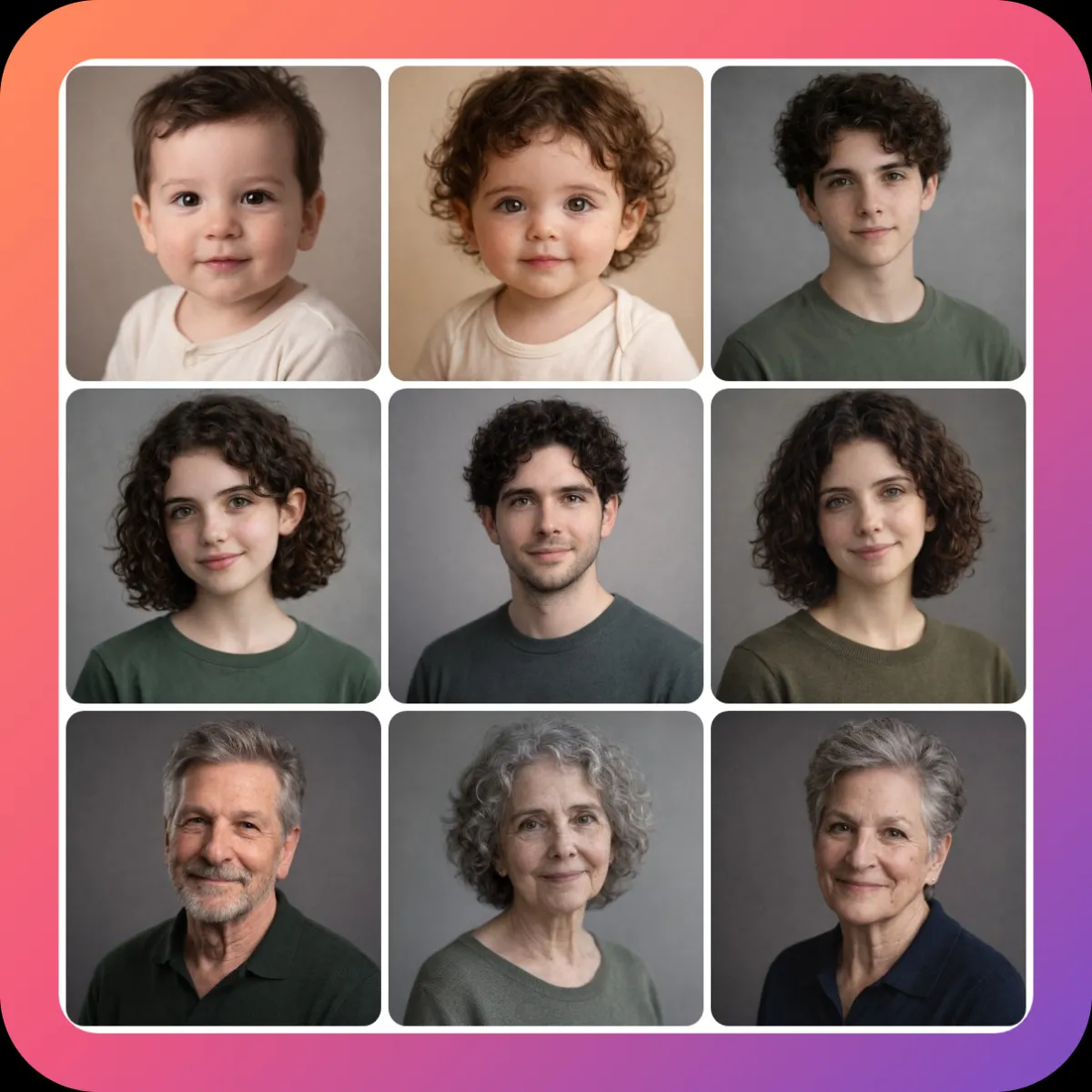
Everything on this page — the dimensions, the absence of a watermark, the untouched download — applies equally to the older ages the same two photos can generate, not only to the newborn.
See all five life stages →“The only one where the result just looked like a baby”
Nobody writes in about file formats. What they mention is whether the picture survived a second look.
“The little nose is one hundred percent mine and that grin is all Kareem, right down to the way it takes over his whole face. We ran it four more times to see if it would change its mind. It kept giving us the same kid.”
“Uploaded two photos, made a cup of tea, and it was finished before the tea was cool. What came back looked like an actual baby photo someone's aunt would post — not a cartoon, not an AI mess.”
“I've tried three of these apps and deleted two within a minute — the babies all had that hollow, slightly haunted look. This is the only one where the result just looked like a baby. I actually saved it.”
Your photos stay yours. Always.
Your photos travel over an encrypted connection, are kept on private storage that is never publicly browsable, and are permanently deleted within 24 hours. We never sell your images or train any AI model on them.
Your results are not published on this site, not listed in our sitemap, and not sitting on a public address — they are held on private storage and reached only through links that expire. There is nothing there for an image search to find.
Full detail, including how we handle facial data under GDPR and applicable US biometric privacy laws, is in our Privacy Policy.
How these photos are made
Every photo on this page, and every photo you receive, is generated by AI. None of them are photographs of a real child, and the babies in the samples above have never existed.
When you upload two photos, an image model reads facial features from both and renders a new picture. It does not find, crop, or retouch an existing photograph of a real child. Real parent faces go in as input; everything that comes out is generated.
We use a model rather than an illustrator because it is the only way to do this in under a minute. What you receive is an AI-made keepsake for entertainment — a creative approximation, not a prediction of a real child, and not medical or genetic information.
Same file on every plan.
Pay once. No subscription, no auto-renewal.
Pay once. No subscription, no auto-renewal.
Pay once. No subscription, no auto-renewal.
Every plan is a single payment. No subscription, no auto-renewal, nothing to cancel. The plans differ in how many photos you get and which ages you can generate — never in the size or quality of the file.
Not sure yet? Start at $1, download the result, and judge it against the five tests above before spending anything more.
Because photos are generated and delivered immediately, all sales are final. See our Refund Policy for details.
Questions about the photos
1024 × 1024 pixels, on every plan including the $1 one. We publish the number because “HD” on its own does not mean anything.
PNG. It is delivered exactly as the model produced it — we do not recompress, resize, or optimise it on the way out, which is what keeps compression artefacts out of the skin.
No, and not on any plan. There is no watermarking step in this product for us to switch on or off.
A 4×4 is crisp and a 5×5 is good; 6×6 is the honest ceiling at this resolution. Larger than that, have a print lab upscale it — their software handles it far better than a home printer. Note the file is square, so a 6×4 or A4 will crop or letterbox.
Yes. No watermark, no branding, no attribution asked for. If you plan to use it commercially rather than personally, note that copyright in AI-generated images is unsettled in several jurisdictions and worth taking advice on.
No. They are AI-generated pictures built from the two photos you upload. They are not photographs of any real child, and not a prediction of one.
No. The plans differ in how many photos you get and which ages you can generate. The file itself is identical on all of them.
Sent over an encrypted connection, kept on private storage, used only to create your portraits, and deleted within 24 hours. Never sold, never used to train any AI model.
No. They are not published on this site, not listed in our sitemap, and not held at a public address — they sit on private storage and are reached only through links that expire, so there is nothing for an image search to index.
Several exist. Most watermark the result, cap you at one low-resolution image, or move you onto a monthly plan. We use one-time pricing starting at $1.
 MyBabyGenerator
A gentle, private glimpse of your future little one — blended from both parents by AI, in under a minute.
FUSIONHUB LLC · 1001 S Main St Ste 600, Kalispell, MT 59901
