Asking about a child rather than a baby is a harder question than it sounds, because a baby's face is not simply a smaller version of the face that child will have at eight.
Between birth and roughly age twelve, the skull grows in a specific and uneven way. Some features are recognizable from the first month. Others barely exist yet. Knowing which is which tells you a great deal about what an AI prediction can and cannot show you.
This is general information about typical growth patterns, not medical advice. Children develop at different rates and variation is normal. If you have concerns about your child's growth or development, speak to your doctor or pediatrician.
What changes between birth and age twelve
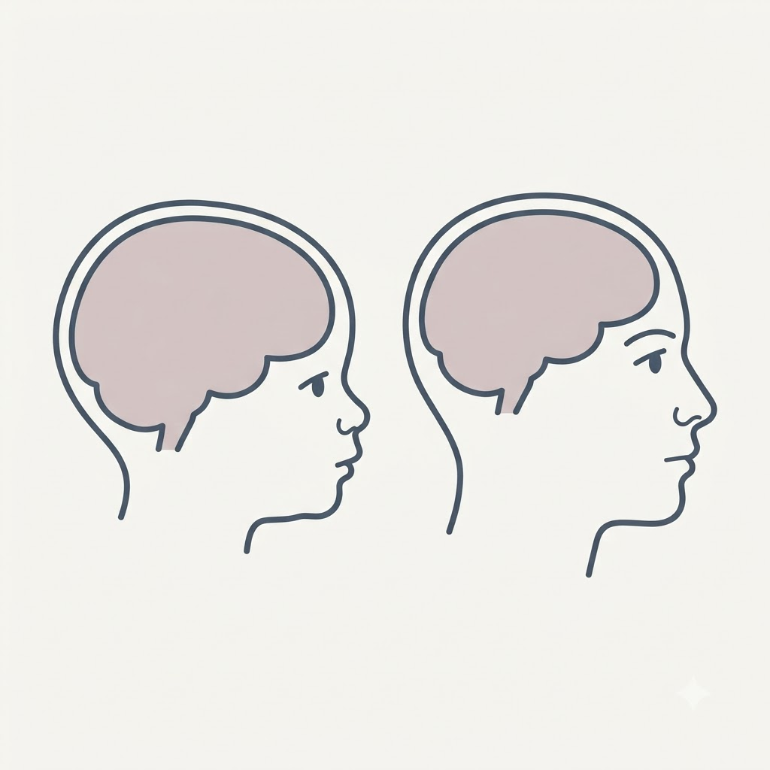
The face grows faster than the braincase. A newborn's head is dominated by the cranium; the facial skeleton is comparatively small. After birth the neurocranium — the part housing the brain — increases in size by roughly half again, while the viscerocranium, the facial skeleton, grows to more than double its size. That difference in rate is the single biggest reason an older child's face looks longer and less top-heavy than a baby's. (Source: Embryology, Craniofacial Growth and Development, StatPearls, NCBI Bookshelf.)
Cheek fullness fades — but not the way people assume. Baby cheeks are round partly because of the buccal fat pad, and the common explanation is that this pad shrinks. Overall it does not, at least not in childhood: a 2025 scoping review of the anatomical literature concluded that the pad is likely to increase in volume between childhood and adulthood, and may not begin to decrease until after the age of sixty or seventy — and that what changes in adulthood is largely position, the pad descending rather than disappearing. What changes in childhood is the ratio. The face grows around a pad that grows more slowly, so the proportion of the face it occupies falls, and the cheeks read as less full. Same tissue, different arithmetic. (Source: Bellity, Pechevy & Carloni, "How Does the Buccal Fat Pad Age and How Can it Be Managed in Facelift Surgery?", Aesthetic Plastic Surgery, 2025.)
The nose emerges. A newborn's nasal bridge is low and the nose is short. It lengthens and the bridge becomes more defined through childhood and on into adolescence — one of the last regions to reach adult proportions.
The jaw lengthens. The mandible grows forward and downward, changing the profile substantially. Along with the nose, it is a late arrival.
The eyes are nearly there already. The eye is closer to its adult dimensions at birth than almost any other organ. Axial length runs about 16.5 to 17.5 mm in a newborn against roughly 23.5 to 24.5 mm in an adult — around two-thirds of the way there on day one, with most of the remainder covered in the first two years. That head start is exactly why babies' eyes look so large for their faces. (Source: Groot et al., "Meta-analysis of ocular axial length in newborns and infants up to 3 years of age", Survey of Ophthalmology, 2021.)
Which features settle early
If you are looking at a baby photo and wondering what survives to age ten, this is the rough order of stability:
Settles earliest: eye size and spacing, ear shape, the general width of the face relative to its height.
Settles later: nose shape, jaw and chin profile, cheek definition.
Least predictable from infancy: hair color and texture, which often change substantially in the first few years — and eye color, which is still moving.
Newborns frequently have little pigment in the iris, which is why so many pairs of eyes look blue at birth; pigment accumulates over the following months. For most children eye color settles after the first year, though for some it keeps shifting for several more. (Sources: American Academy of Ophthalmology, "Your Blue Eyes Aren't Really Blue"; American Academy of Pediatrics, HealthyChildren.org.)
There is a neat consequence buried in that ordering. Family resemblance often becomes more obvious as a child gets older, not less — because the features that carry resemblance most strongly, the nose and jaw and cheekbones, are precisely the ones that arrive late.
Why AI predictions get vaguer with age
Two problems stack, and they compound.
The target gets wider. An image model generating a "child" is drawing on what child faces look like in the data it learned from. For a newborn, the space of plausible faces is comparatively narrow — newborns genuinely do look more like each other than eight-year-olds do. For an older child the space is much wider, and a model with more room drifts toward the middle of it.
The model has to do two jobs at once. It is working from adult parent photos and has to infer both a blend and an age. Each step introduces uncertainty, and the second inherits the first.
The practical effect is that the older the target age, the more generic the output looks. You get a pleasant, plausible child who resembles the parents in a general way — and the specific features that would make them recognizably your child are exactly the ones the model is least likely to land.
Which lines up neatly with the anatomy above. The features that carry family resemblance are the late-arriving ones, and late-arriving features are the ones with the widest range of possible outcomes. Both the biology and the model get less certain in the same direction.
Setting expectations that hold
What a generated child image is good for: a general sense of family resemblance, a nice thing to look at, something to share.
What it is not good for: anything you would be disappointed to find wrong. If you look at a generated eight-year-old and feel you have met your future child, the tool has oversold itself and the disappointment is scheduled rather than avoided.
The wider version of this — what these tools can and cannot show at any age — is in what will my baby look like. And if you are wondering why running it twice gives two different children, that is covered separately.
Getting a better result at older ages
- Use the best possible parent photos. Age prediction amplifies input noise rather than smoothing it, so a mediocre photo costs you more here than it does on a newborn. The step-by-step guide covers what "best" means concretely.
- Generate the baby version too. Comparing baby and child output from the same two photos shows you which features the model treats as stable — genuinely more informative than either image alone.
- Run it more than once at the same age setting. Features that recur across runs are worth more attention than features that appear once.
Frequently asked questions
At what age does a child's face stop changing? It doesn't, exactly — facial growth continues into late adolescence, with the nose and jaw among the last regions to reach adult proportions. The braincase finishes considerably earlier than the face does.
Why did my baby's eye color change? Newborns often have little pigment in the iris, and melanin accumulates over the following months. Most children's eye color has settled after the first year, though it can keep changing for longer in some.
Is the child prediction less reliable than the baby one? Yes, and for a structural reason rather than a technical one: the range of plausible faces widens with age, so the output drifts toward an average. Nothing about a better model would fix that.
Will my child look more like me or my partner? No tool can answer this, and neither can a photograph. Resemblance often shifts as a child grows, and features from grandparents can surface at any point.
Which ages can the tool show? The tool covers five: baby, kid, teenager, adult and elderly. Each is generated separately rather than aged forward from a single image, so results at different stages are independent of each other. Which of the five your own purchase unlocks depends on the pack — the pricing page has the breakdown.
What does it cost? It isn't free. Every plan is a single payment — there is no subscription and nothing to cancel afterwards. The packs differ in how many portraits you get and which life stages they unlock, so if it is specifically the kid or teenager stage you want, check what your pack covers on the pricing page before you buy. Most apps in this category work the other way round: free to download, then a weekly subscription at the result — we went through that pattern here.
The bottom line
The face a child has at ten is built largely out of features that do not exist yet at six months. The nose, the jaw, the cheekbones — the parts that make a person look like their family — all arrive late and vary widely.
That is why a generated newborn feels convincing and a generated ten-year-old feels a bit like a stock photo. It is not the model failing. It is the model running out of information at roughly the same point the biology does.
This article was drafted with AI assistance and reviewed, fact-checked and edited by a human before publication. Statements about facial and ocular growth are sourced from StatPearls (NCBI Bookshelf), Survey of Ophthalmology, the American Academy of Ophthalmology and the American Academy of Pediatrics, linked inline.